|
3.12 Carrying
Lenses in the Field
For those readers who’ve never
actually held a big birding lens in their hands, a reality check may be
in order if you’re thinking of buying one of these monsters. The
largest of the super-telephoto lenses used by pro bird
photographers are not only expensive, they’re also heavy and awkward to
carry around in the wilderness when searching for birds. The
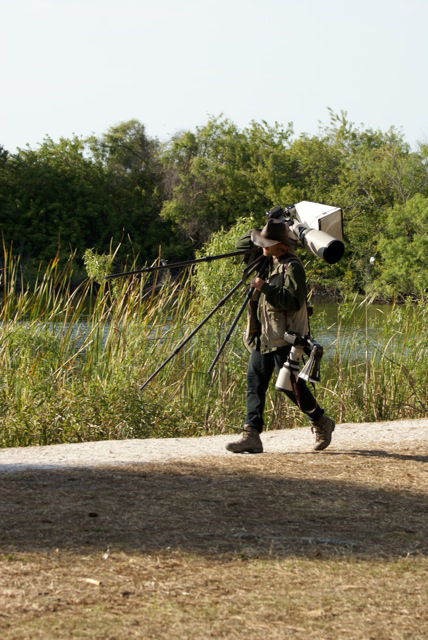
image below shows the author carrying his big 600mm f/4 lens,
tripod-mounted and with a large flash extender attached, over one
shoulder while a smaller (but still sizeable) 400mm f/4 lens with
external flash unit and flash extender hangs from the other shoulder.
Fig. 3.12.1:
The author, at the legendary Venice Rookery in Florida.
Over the right shoulder is a tripod-mounted 600mm f/4 lens.
Over the left shoulder is a 400mm f/4 lens on a strap.
(Photo by Linda Huber, used with permission).
In terms of carrying the largest lenses—namely, the 500mm f/4, 600mm f/4,
and 800mm f/5.6 lenses of
various brands—the most common method is to
leave the lens attached to the tripod and to pick up the tripod and
sling it over one’s shoulder. This is very, very dangerous!
As you might be able to discern from the above photo, I keep a firm old
of the gimbal head that the lens is attached to whenever carrying the
tripod-mounted setup in this way. There’s a reason for this.
Over the years I’ve heard a number of first-hand
accounts involving the loss of large telephoto lenses when carried as
shown in the photo above. Two warrant mentioning here. The
first involved a photographer using the same lens shown above (the
Canon 600mm f/4 lens, which
runs about US $8000) mounted on a cheap
monopod. When the chap hoisted the lens onto his shoulder, the
tiny screw holding the monopod’s head in place on the end of the
monopod snapped, allowing the lens and camera to fall to the
ground. But the photographer was on a bridge over “troubled
waters”, so to speak. The lens and
camera rolled off the bridge
and into an alligator-infested lake. The photographer had to hire
professional divers to brave the reptiles’ domain and retrieve the
lens, which Canon later proclaimed was unfixable. This story was
posted on an internet forum by the photographer himself, who provided
photographic documentation of the recovery effort by the professional
diving team.
The other story was related to me by a fellow
photographer in Ohio. While birding in some remote location with
his Sigma 800mm lens and Nikon D700 digital camera, he slung the
tripod-mounted rig
over his shoulder to find that the lens bracket wasn’t totally secure
in the
tripod head’s quick-release clamp. The
lens and camera slid off the tripod and hurled
toward the ground. The camera was crushed by the force of impact,
and completely demolished. The 800mm lens snapped in half, but
was ultimately repaired by the manufacturer.
The moral of the story (or stories) is that bad
things can happen if you don’t take care to carry your lens properly in
the field. Many birders simply sling their tripod-mounted
lens/camera over their shoulder, apparently unaware that many tripod
heads are held in place by a tiny, 15-cent screw that is likely not
rated for the amount of torque applied by the maneuver. If you’re
going to use the tripod-over-the-shoulder
approach, at least keep one
hand firmly on the lens foot or on the tripod head, so that if the head
detaches from the tripod, you’ll still have a chance to keep the
lens/camera from falling to the ground.
Another option for the super-big lenses typically
used on tripods is to detach the lens from the tripod and sling it, via
a lens strap, over your shoulder while you carry the tripod
separately. For long hikes I do this, while always being sure to
check the strap itself to make certain that it shows no sign of coming
un-fastened from the lens.
For smaller lenses used without a tripod, it’s a
good idea to make sure you’re using a dependable strap. I once
had a strap break just as I was setting a lens on the seat of my car
(it wasn’t damaged). It’s worth spending an extra $10 or $20 for
a robust strap to protect your $1000+ lens. In terms of actual
use in the field, I prefer to sling the strap over my shoulder rather
than my neck, since a heavy 400mm lens around your neck can cause some
seriously sore muscles by the end of the day. If you do sling
your camera/lens over your shoulder via the strap, be extra vigilant at
all times to make sure the strap doesn’t slide off your shoulder.
I only use straps with rubber backing, which provides extra friction
and helps keep the strap on my shoulder. I also keep my elbow
bent at a 90-degree angle at all times when a camera is slung over my
shoulder, so that if the strap slips off my shoulder it’ll at least
catch onto my forearm and hopefully prevent damage to the camera or
lens.
One other option to consider—if you’re fairly strong and don’t
have any back problems—is to carry your big telephoto
lens on a sling strap, such
as those offered by the company Black
Rapid. I now do most of my birding using a 500mm f/4 lens (usually with a 1.4× teleconverter attached)
hand-held, with the Black Rapid strap providing a safety net in case I
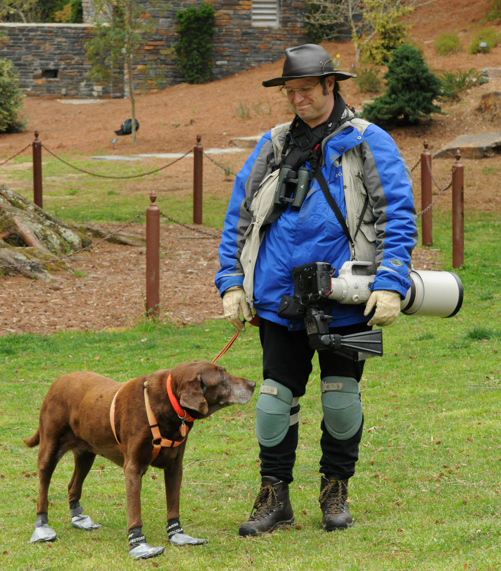
drop the lens. The image below illustrates this.
Fig. 3.12.2:
The author with his 500mm lens attached to the
Black Rapid sling strap. This is for hand-held work. The
sling strap allows the lens to be rapidly raised to eye-level.
Not having to use a tripod results in greater mobility, while
a monopod can still be carried along just in case it’s needed.
(Photo by Caroline Gilmore, used with permission.)
Because the Black Rapid allows you
to very rapidly raise the camera up to your eye, this method works well
in the field because you can very quickly get set up for a shot without
having to deal with positioning your tripod, extending its legs,
loosening the tripod head, etc. The problem is, of course, that
hand-holding a big lens like this takes great discipline. It
doesn’t actually require enormous strength (I’m no body-builder
myself), but rather balance.
When holding the camera up to my eye to take a shot, I balance the lens
in my left hand by grasping the foot of the lens collar and planting my
elbow against my ribs. By maintaining the proper balance I’m able
to avoid getting too fatigued while holding the lens up to my
eye. However, I also usually carry along a monopod, just in case
my arms do get tired. The monopod (not shown in the figure above)
is easy to carry, since I have it attached to a carabiner clip that I
can just clip onto my belt. When walking, I do keep one hand on
the handle (collar foot) both in case
the strap breaks, and to take some of the weight of the lens off the
strap’s hardware. Note that most sling straps are probably not
rated for the weight of a 500mm rig, so use this technique at your own
risk. My Black Rapid’s metal hardware is showing some signs of
wear after just two months, but it looks like it should hold up for
quite a while yet before needing to be replaced. (Many thanks to Al and
Troy from Magee Marsh for introducing me to this technique!)
|
|
|